Custom agentic monitoring
Tell MIND AIoT what deserves attention: a room getting too warm, a sensor that stops updating, a pump running too long. Alarm logic follows the rules that matter to you.
The Manna MIND AIoT platform
MIND AIoT is monitoring and control software built around the MIND AIoT Node — an embedded Linux computer like Raspberry Pi 5 — open to any hardware you connect. AIoT means Agentic IoT: AI agents integrate components, develop custom features and keep watch over your operation. Licensed as software and ready to start.
Next level monitoring and diagnostics
Tell MIND AIoT what deserves attention: a room getting too warm, a sensor that stops updating, a pump running too long. Alarm logic follows the rules that matter to you.
Agents investigate device health and data flow in the background, trace an unusual reading to a sensor, connection or software issue and explain what needs attention.
Ask for a daily exception report, a comparison of production rooms or a follow-up on a production stage — delivered in the format your team or customers need.
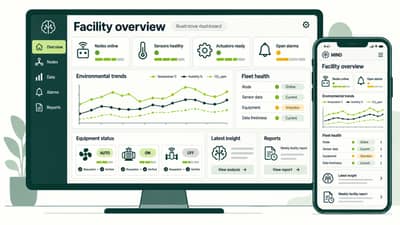
Hardware freedom, by design
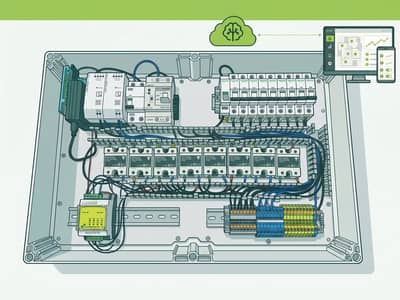
Use off-the-shelf components or equipment you build yourself — sensors, controllers, actuators, relays and modules — in existing facilities or new spaces. They connect directly or through a third-party interface, wired or wirelessly: Bluetooth, WiFi, Ethernet, I2C, SPI, USB, analog, Modbus and other digital interfaces supported by Raspberry Pi 5 and embedded Linux.
Given an accessible interface and the component’s documentation, agents develop the driver, test it on a test node with the actual hardware and document it as a feature you can use on all your nodes. MIND AIoT is a software licence, so the hardware stays your choice.
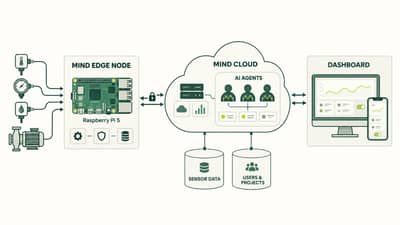
Platform architecture
An embedded Linux computer running MIND AIoT Node OS, with memory for the system and an encryption key. Raspberry Pi 5 and industrial Compute Modules are supported today. It connects your components, runs local automation on site and communicates with the backend.
Stores data, runs agentic workflows, maintains customer-specific code, analyses data and carries out the work you ask for. The REST API connects third-party data sources and your own scripts.
One place to follow your data, manage devices and describe new monitoring, logic or reports.
Sensor history and documents in databases designed for industrial use.
Why this node? Manna selects and maintains it, so the rest of the system stays your choice. Raspberry Pi 5 was chosen for its versatility, robustness, worldwide availability and low cost, with industrial variants through the Compute Module. Support is expanding to more embedded Linux computers, and a custom MIND AIoT Node OS image can be built for the computer architecture you already use.
Agentic software development
For the edge device: define a control routine, sensor calculation or equipment sequence close to the physical process — for example, ventilation controlled from local temperature readings.
In the cloud: combine data from multiple edge devices — compare production rooms, investigate a shared pattern or build a site-wide report.
Describe what you want; agents turn it into tested software across your devices and cloud, with the discipline industrial automation needs: tested changes, dependable local control and a maintained system. A small team builds and owns what used to need a large engineering project.
Documentation that keeps itself current: the platform and its agents maintain a live PRD and wiki for your system — bill of materials, features, requirements and user instructions — ready for training workers or onboarding partners.
From your idea to the next capability
You bring the hardware and the goal; MIND AIoT and its agents do the software work.
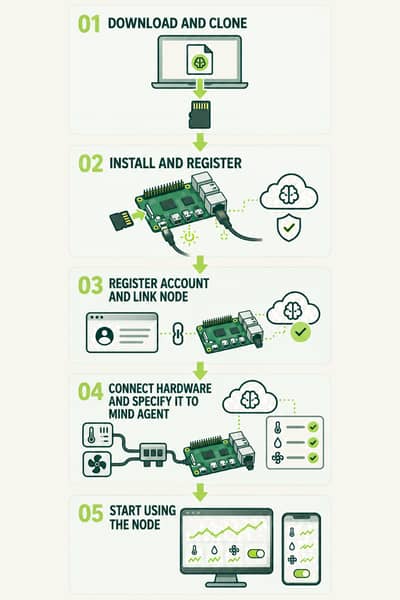
Getting started — once
Write MIND AIoT Node OS for Raspberry Pi 5 to a memory card and start the node.
Register the node in the MIND AIoT dashboard and link it to your system.
Tell the platform which sensors, actuators and equipment are connected, and the monitoring, logic, analytics and reports you want.
Controlled development — every change
Specify what to connect or build, with its interface and documentation.
Give test permission: agents connect, develop, debug and test there — and only there.
Agents report the results and the code for your review.
The accepted feature is published to your operating nodes, and a working version is kept so a change can be returned to.
Afterwards the feature is deterministic software: it runs the same logic every time, on the node and in the cloud, and deployed code is not changed in the background. Agents keep monitoring and reporting.
Licensing and ownership
Traditional IoT work is priced project by project — new scoping, quotations and change risk for every feature. MIND AIoT keeps developing inside the licence.
Monthly, annual or site-level, agreed for your project. New components, monitoring and alarm logic, dashboards and reporting stay inside the licence instead of becoming separate R&D projects.
MIND AIoT can be licensed and hosted on your own servers, and the code generated for your system stays available to you. There is no hardware vendor lock-in.
Your main investment is the hardware and its installation; the software is the licence that makes it work.
Scope, hosting and support are agreed for your project.
Agentic workflows are part of the platform
Built-in agentic workflows
MIND AIoT is in use in many systems and facilities. Manna runs customer-specific agentic workflows for monitoring, issue investigation and software changes, built on IoT-specific test harnesses and agents trained for architecture, testing, debugging, monitoring and data analysis.
Being developed and validated
We’re extending customer-directed integration, generated interfaces and reusable adaptations, building on the agentic workflows already in the platform.
Bring your next idea
Tell us about a component you want to connect, a feature you need or a question your data should answer.